To promote the development of department and deepen international cooperation and exchange, the Department of Rheumatology at the Guangdong Provincial People’s Hospital had the honor of inviting Prof. Martin Aringer, a renowned international expert in rheumatology, the first author of the 2019 EULAR/ACR Classification Criteria for Systemic Lupus Erythematosus (SLE), and a professor at the Faculty of Medicine, Dresden University of Technology, Germany, to visit the hospital for teaching rounds and complex case discussions on 7 November, 2024. The visit was chaired by Chief Dr. Li Yang, the head of the Department of Rheumatology, and attracted over 40 participants, including experts, resident doctors, and postgraduate students from both inside and across the department.
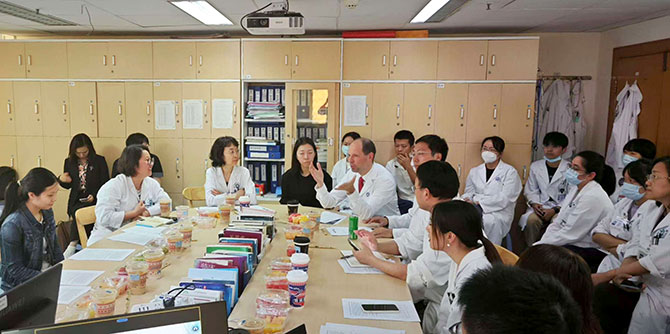
Chief Dr. Li Yang warmly welcomed Prof. Aringer and briefly introduced the development history, clinical characteristics, and recent achievements in the research and teaching of the department. During the academic exchange session, Prof. Aringer visited the ward and participated in detailed clinical case rounds and multidisciplinary team (MDT) discussions.
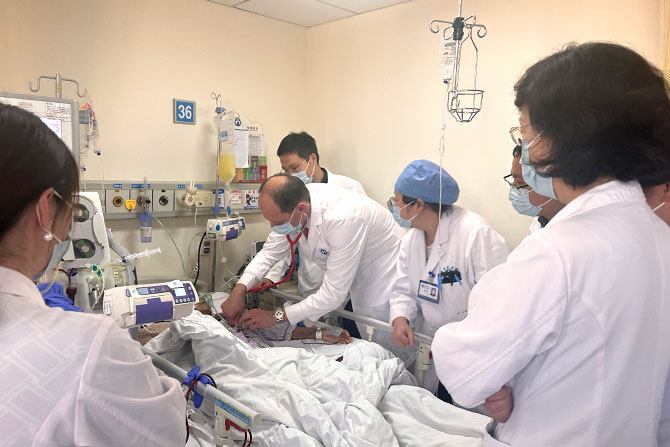
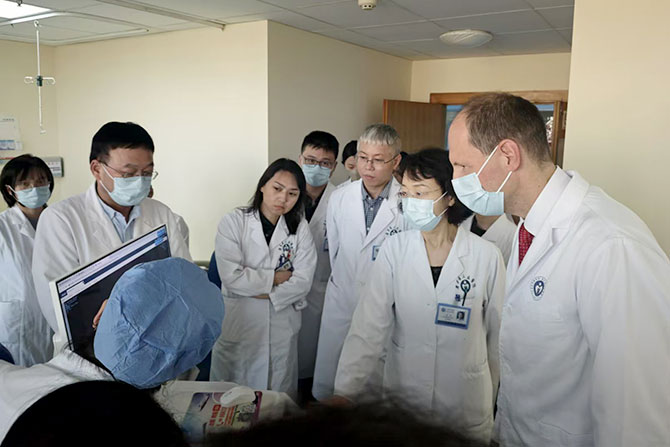
During the ward rounds, Prof. Aringer conducted thorough consultations and physical examinations of two patients with complex cases. One case was a patient with suspected SLE but with numerous diagnostic uncertainties, and the other was a severe SLE patient with concurrent heart failure, acute alveolar hemorrhage, and thrombotic microangiopathy. Following the ward rounds, Prof. Aringer joined the MDT case discussion, where experts from the Departments of Cardiology, Nephrology, Pathology, Laboratory Medicine, and Respiratory and Critical Care Medicine shared their insights on diagnostic challenges, treatment options, and the importance of multidisciplinary collaboration. Prof. Aringer provided in-depth and detailed analyses of the cases based on the latest international guidelines and clinical experience, and offered valuable diagnostic and therapeutic suggestions. He highly praised the professionalism and rigor of the rheumatology and immunology team in managing complex cases, emphasizing that such an academic atmosphere and multidisciplinary team spirit are crucial, reflecting advanced international standards in rheumatology and immunology care.
Additionally, Prof. Aringer shared his latest research progress on biologic target drug therapies for SLE, discussing the potential role and challenges of targeted treatments in controlling disease activity. He presented extensive empirical research and clinical trial data, highlighting that personalized treatment for SLE is a key direction for future development, and stressed the potential of approaches like interferon pathway blockade in precision medicine. The attending doctors actively engaged with questions, and Prof. Aringer patiently addressed each one, particularly offering valuable suggestions on how to flexibly apply international guidelines and optimize the use of biologics in SLE treatment.
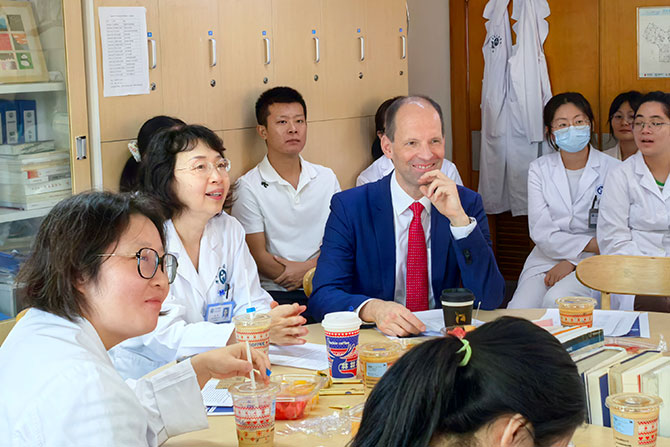
Finally, Chief Dr. Li Yang summarized the academic event. She noted that as a leading figure in the international field of rheumatology, Prof. Aringer’s rich research background and unique insights into SLE are highly recognized. His visit and exchange not only broadened the academic horizons of the hospital’s medical staff but also provided practical guidance for clinical diagnosis and treatment. This visit is of great significance for strengthening international academic cooperation within the department and enhancing clinical skills, and the department will continue to promote such high-level academic exchanges to advance the overall quality of care.
Prof. Aringer has over 31 years of professional experience. He is a professor of medicine at the Medical Center and Faculty of Medicine, Dresden University of Technology, Germany, and the head of the Department of Rheumatology, as well as the director of the Interdisciplinary University Center for Autoimmune and Rheumatic Entities (UCARE). His research focuses on autoimmune diseases such as SLE and systemic sclerosis. He serves as a member of the EULAR Education Committee and the Board of the German Society for Rheumatology, and is also a member of the Austrian Society for Rheumatology and the American College of Rheumatology. From 2014 to 2019, he was the co-chair of the EULAR/ACR SLE Classification Criteria Project, and has received the Young Investigator Award from the EULAR and the Austrian State Prize for basic research in rheumatology. Prof. Aringer has published more than 350 scientific papers, including the 2019 EULAR/ACR SLE Classification Criteria, which is widely recognized and used globally.
Lin Haobo
Updated: 22 November, 2024