With the advancement of breast cancer diagnosis and treatment, the prognosis of breast cancer patients has significantly improved. Patients’ long-term quality of life and their demand for breast aesthetics have become a major focus in the field of breast cancer. The robotic surgical systems, with advantages of intelligence, remote operation, minimal invasiveness, and digitalization, have overcome the limitations of traditional manual surgery and have become a research hotspot in breast surgery in recent years. Since the da Vinci Surgical System was launched in 2000, the development of robotic surgery in China has been rapid. At the recently concluded 43rd European Society of Surgical Oncology (ESSO) Annual Conference in 2024, Prof. Liao Ning from the Guangdong Provincial People’s Hospital, presented an oral report on her research titled “Robot-assisted lumpectomy for breast cancer with negative margins”. This research garnered significant international attention, making it the first to precisely guide robotic-assisted breast-conserving surgery using molecular imaging technology.
Prof. Liao Ning’s Team Gains International Recognition for Robotic-Assisted Breast-Conserving Surgery Research
In recent years, robotic surgical systems have played a crucial role in breast surgery, marking a new trend in the field. However, the application of robots in breast surgery has primarily been in robotic-assisted nipple-sparing mastectomy (NSM), deep inferior epigastric perforator (DIEP) flap breast reconstruction, axillary lymph node dissection, and excision of benign tumors, with no previous reports on robotic-assisted breast-conserving surgery. To further expand the clinical applications of robotic-assisted surgery for breast cancer and provide more natural and aesthetically pleasing breast appearances for breast cancer patients, Prof. Liao Ning’s team conducted this study on robotic-assisted breast-conserving surgery.
This research, the first to use molecular imaging technology for precise guidance in robotic-assisted breast-conserving surgery, was selected for the oral presentation session at ESSO due to its innovativeness and breakthrough. It is reported that Prof. Liao Ning is the first Chinese surgical expert to deliver an oral presentation at the ESSO conference, receiving high praise from experts around the world. The technical prowess of Chinese scholars in robotic-assisted breast cancer surgery has been widely recognized.
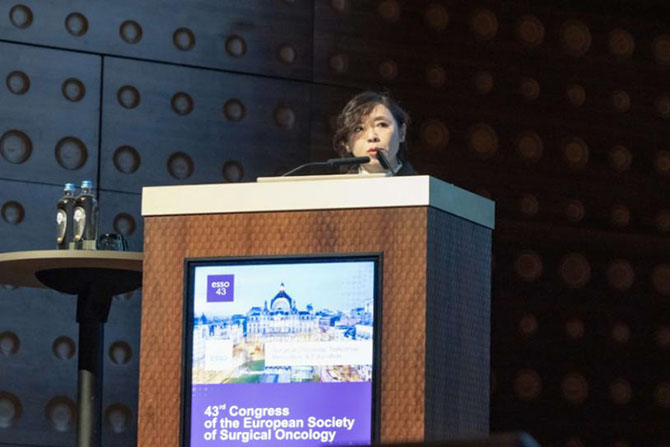
Prof. Liao Ning Delivers an Impressive Presentation at the ESSO Conference
In her presentation, Prof. Liao Ning highlighted that the study was conducted based on an analysis of 150 breast cancer patients. The results indicated that robotic-assisted breast-conserving surgery is a safe and feasible surgical option, particularly suitable for patients whose tumors are more than 1 cm away from the skin, providing them with a more natural and beautiful breast appearance. At the end of her presentation, Prof. Liao Ning expressed that her team plans to conduct further international multicenter studies to promote the progress and application of robotic-assisted breast-conserving surgery.
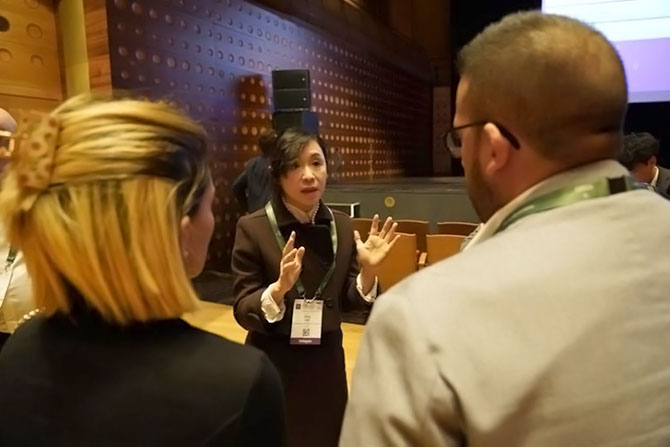
Prof. Liao Ning Engages in Discussions with Experts
The Robotic Surgical Systems Will Help Breast Surgery Enter a New Era of “Less Invasive and More Precise”
Breast cancer is one of the most common malignant tumors in women, with about 2.3 million new cases diagnosed globally each year. In recent decades, with the overall advancement of comprehensive diagnosis and treatment, the prognosis of breast cancer patients has steadily improved, with the 5-year survival rate for early-stage breast cancer patients now exceeding 90%. In this context, the long-term quality of life and aesthetic demands of breast cancer patients have received increasing attention. Recent advancements, including the widespread application of liquid biopsy technology, the improvement of anti-tumor drugs from intravenous to subcutaneous formulations, and the rapid development of robotic surgical systems, have greatly contributed to improving the long-term quality of life of breast cancer patients and promoting their physical and mental rehabilitation.
Robotic surgical systems, with their intelligence, remote capabilities, minimal invasiveness, and digitalization, offer significant advantages over conventional open or laparoscopic surgery in breast surgery, leading to the development of new surgical techniques and benefiting more breast cancer patients. The systems feature uniquely jointed and ergonomically designed flexible arms, as well as a 3D imaging system that provides ten times magnification. This makes it particularly suitable for surgeries in confined spaces, resulting in smaller incisions and more concealed surgical wounds, which help more breast cancer patients achieve a more beautiful breast appearance. However, as robotic surgery systems are remote-operated, grasping the anatomical layers during breast surgery requires greater experience from the surgeon. Additionally, the lack of directional cues in the breast, a solid organ, presents many challenges in confirming the surgical area and precisely removing the tumor during the operation.
With the widespread application of AI technology in recent years, research on robotic surgical systems has made significant progress, further improving surgical accuracy and reducing damage to surrounding tissues. Based on this, Prof. Liao Ning’s team analyzed the feasibility of robotic-assisted breast-conserving surgery using molecular imaging technology in 150 cases of robotic-assisted breast cancer surgery. This research is the first of its kind in breast surgery, providing more evidence-based medical evidence for the clinical practice of robotic-assisted breast-conserving surgery. Moreover, in this study, the robotic-assisted breast-conserving surgery performed through the axillary incision significantly increased patients’ satisfaction with postoperative wound location, wound appearance, and overall breast appearance, offering better aesthetic outcomes, especially for patients whose tumors are more than 1 cm away from the skin.
Although robotic surgical systems currently face issues such as high costs and lengthy setup times, in the era of rapid technological development, these systems are continuously being optimized and innovated. For example, the trend of domestically developing and producing surgical robots in recent years has become increasingly prominent, with several domestically produced surgical robots already approved for the market, which will help further reduce costs. It is believed that with the advancement of science and technology and the popularization of domestic surgical robots, robotic-assisted breast cancer surgery will move towards being even less invasive and more precise. More and more breast cancer patients will be able to achieve their beauty goals and enjoy a higher long-term quality of life through precise surgical treatments.
Department of Breast Cancer
Updated: 5 November, 2024