IgA nephropathy (IgAN) is the most common primary glomerular disease, yet its pathogenesis remains incompletely understood. Galactose-deficient IgA1 (Gd-IgA1) is a key pathogenic protein in IgAN, but the mechanisms behind its specific deposition in the glomerular mesangium and its impact on mesangial cell fate have remained unclear.
On July 1, 2025, a research team led by Prof. Yu Xueqing from the Guangdong Academy of Medical Sciences/Guangdong Provincial People’s Hospital published a groundbreaking study in Nature Communications (IF: 15.7) titled Lysosome-Mediated Aggregation of Galactose-Deficient IgA1 with Transferrin Receptor 1 Links to IgA Nephropathy. The study focuses on a central process in Gd-IgA1 deposition in the kidney, revealing how mesangial cells bind and internalize Gd-IgA1 via transferrin receptor 1 (TfR1), leading to the formation of persistent protein aggregates in lysosomes. This triggers lysosomal dysfunction and inflammatory responses.
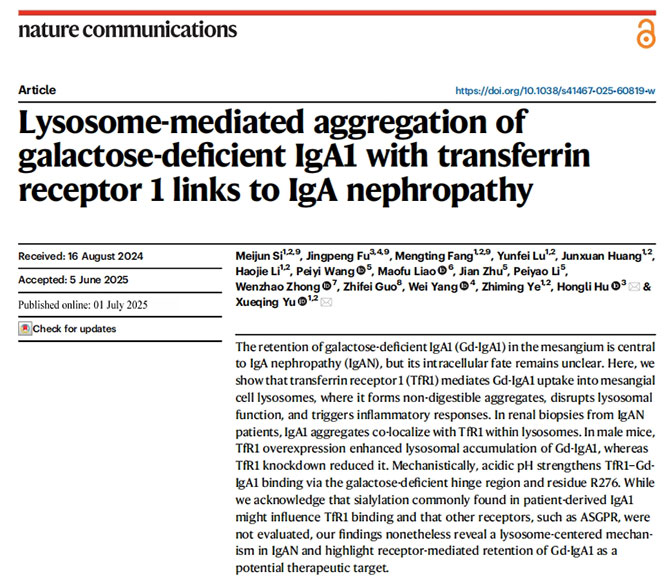
The study identifies TfR1 as the key receptor mediating Gd-IgA1 entry into mesangial cells. The intracellular accumulation of Gd-IgA1 impairs lysosomal function. In kidney biopsy samples from IgAN patients, co-localization of TfR1 and IgA1 was observed within lysosomes. Animal model experiments further confirmed that TfR1 overexpression exacerbates Gd-IgA1 accumulation in lysosomes, while knocking down TfR1 significantly reduces its deposition. Protein interaction assays showed that the acidic lysosomal environment promotes binding between TfR1 and Gd-IgA1. Through mass spectrometry, key amino acid sites involved in this interaction were identified, with the hinge region of Gd-IgA1 playing a critical role, offering new directions for potential therapeutic targeting.
This research proposes a novel intracellular pathogenic axis: “Gd-IgA1 binding to TfR1 – internalization – lysosomal dysfunction – inflammatory activation of mesangial cells.” It provides new insights into the pathological mechanisms of IgAN, complementing the traditional view that Gd-IgA1 complexes mainly deposit extracellularly and drive disease via complement activation. The study also suggests that targeting the hinge region of Gd-IgA1 could represent a promising intervention strategy.
Si Meijun, Associate Researcher at Guangdong Provincial People’s Hospital, and Fu Jingpeng, PhD from The Chinese University of Hong Kong, Shenzhen, are co-first authors of the article.
Department of Nephrology
Updated: July 3, 2025